
Back to all
i-Smart End Mills - excellent flexibility by using copy milling coupling(1)
30 Nov 2022
Information provided by
Product manager of round tools in EMEA
Exchangeable tooling saving expensive carbide is the ambition of all industry suppliers. However, the demands of milling require special attention and a special strategy due to the inherent weakness of having a connection point of a modular system.
Ability to deal with radial forces is key
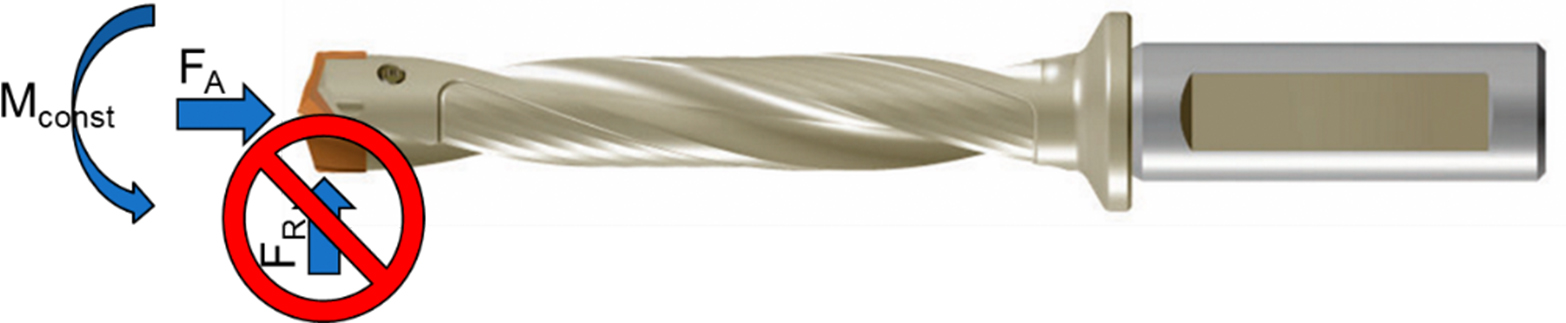
Exchangeable drilling systems like our YG-1 Spade Drills are well recognized in the marketplace, have a long history and are well proven technology. During drilling the drill must deal primarily with axial and radial torque forces, and the amplitudes of the cutting forces are relatively small keeping the impact to the coupling or pocket seat manageable. The highly sophisticated pocket seat of i-OneDrill for example can perfectly deal with those.
But all exchangeable or modular drilling systems do not like radial forces. These occur at inclined exits, cross holes, chained holes etc. and respectively reduce the tool life of the entire system drastically.
Milling on the other hand consists of high radial forces and especially high amplitude torque due to the interrupted cut. These two types of forces combined make it very difficult to come up with a solution that is able to keep up with normal solid carbide end mills. Also we need to consider that the greater the length of cut (LOC) the more bending moment is added to the forces putting the coupling under severe stress.
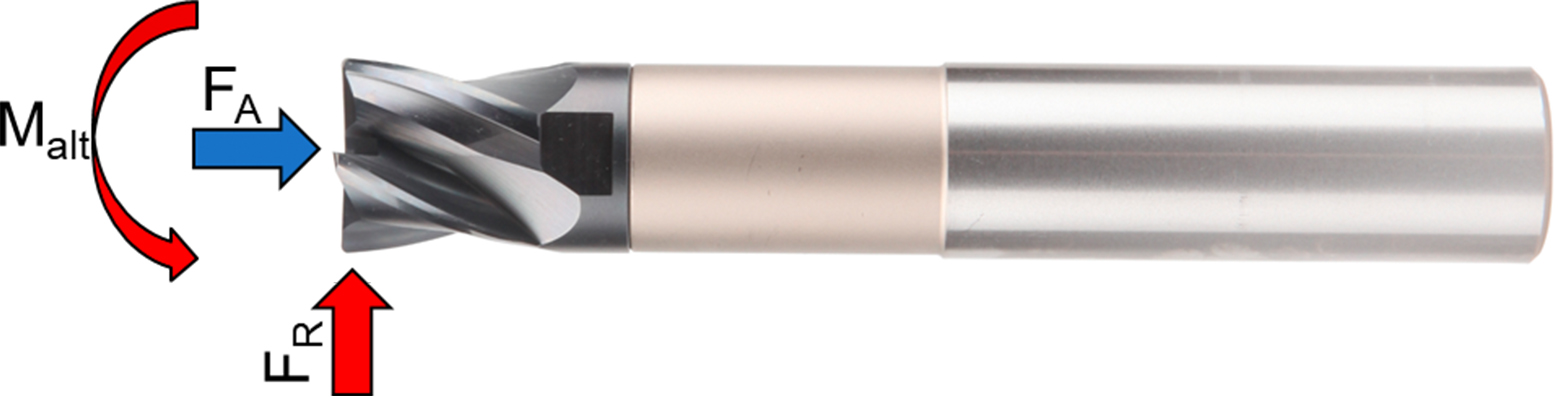
All of this is easy to cover with regular end mills.
Sweet spot of modular end mills
Beside WELDON flats most regular carbide end mills do not need additional grinding on the shank section once the blanks are made. With modular end mills the coupling requires extensive grinding at the highest accuracy which drives the cost up compared to a standard carbide endmill. That’s why the sweet spot of those tools are medium to large sizes, long reach length or the comfort of exchanging the cutting tip inside the machine. Small sizes, short overhangs or cutting edges are difficult to justify for modular end milling systems.
But there are additional benefits of modular end mills:
• Re-use of the shanks multiple times.
• Flexibility of lengths and extensions saves carbide.
• Dimensions and shapes of conical steel or heavy metal shanks can be tailored to the application.
• Custom solution adaptation including vibration dampening counterweights.
• Integral shanks having the machine spindle connection for maximum stability.
• Internal coolant supply is easier to obtain with standardized blanks for these cutters than with regular end mills.
• Ease of setup for driven tooling inside a lathe greatly simplifies the tool change process and reduces the need to re-touch off the tools.
about the author
 |
Thilo Mueller Product manager of round tools in EMEA |
Comments
Leave your comment
Close